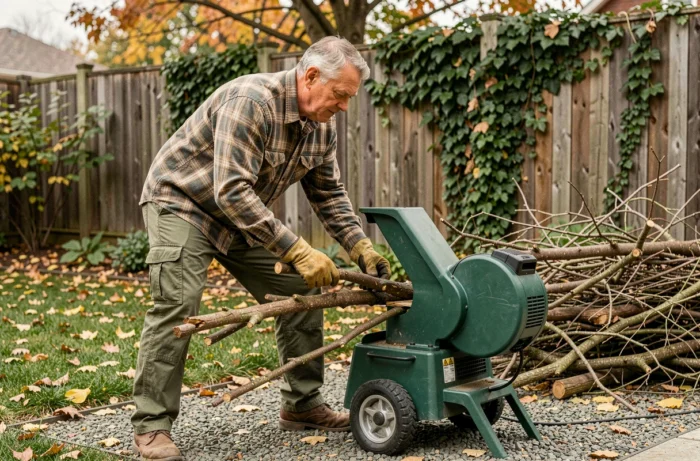
The Bosch AXT 25 D is part of Bosch’s so-called “silent” range, equipped with a knife rotor instead of a turbine system. This technical choice directly influences the grinding throughput, the type of vegetation accepted, and the budget. Before investing in this electric garden shredder, it is useful to measure what its specifications actually allow in practice, and where they find their limits.
Bosch AXT 25 D compared to other shredders in the Bosch range
Comparing the AXT 25 D to neighboring models from the same brand allows for a precise positioning. The table below gathers the data declared by the manufacturer for the four shredders in the Bosch silent range.
| Model | Power | Max. diameter announced | Cutting system |
|---|---|---|---|
| AXT 22 D | 2,200 W | 38 mm | Knife rotor |
| AXT 25 D | 2,500 W | 40 mm | Knife rotor |
| AXT 23 TC | 2,300 W | 42 mm | Turbine |
| AXT 25 TC | 2,500 W | 45 mm | Turbine |
The AXT 25 D and the AXT 25 TC share the same motor power. The difference lies in the cutting system. The knife rotor of the 25 D operates like a large gear that turns slowly, pulling the branch down. The turbine of the 25 TC, on the other hand, offers a higher throughput and accepts wider sections.
For those looking for a review of the Bosch AXT 25 D in real-world conditions, the price difference between the two models remains the determining factor. The 25 D is positioned significantly below the 25 TC, making it the logical choice for a medium-sized garden where the volume of branches does not justify the investment in a turbine system.
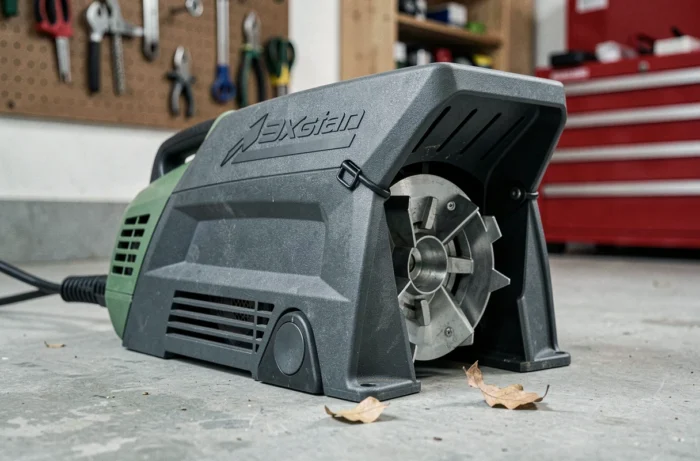
Actual grinding of the AXT 25 D: dry branches, green wood, and jams
The maximum diameter of 40 mm is a manufacturer specification. In practice, user feedback paints a more nuanced picture. Dry branches pass through correctly, including those close to the limit. The rotor catches them and shreds them without prolonged manual intervention.
Fresh vegetation poses more difficulties. Reports indicate that leafy or herbaceous waste can wrap around the rotor shaft and cause jams. This behavior is not an isolated defect: it stems from the very principle of the knife rotor, which crushes and pulls rather than cutting cleanly.
Beyond about 4 cm in diameter, blockages occur regularly. The cut becomes rough, and it is often necessary to engage reverse to clear the shredder. Two key points to remember:
- Optimal grinding occurs on branches of 2 to 3.5 cm in diameter, dry or semi-dry, where the rotor operates without straining.
- Fresh hedge trimmings, rich in leaves and soft twigs, slow down the throughput and increase the frequency of manual interventions.
- The pusher included with the device helps guide stubborn vegetation, but does not resolve jams caused by wrapped wet fibers.
Weight, storage, and maneuverability of the Bosch AXT 25 D shredder
With a stated weight of 31.3 kg, the AXT 25 D is not a device that is moved lightly. This is a detail that product sheets mention without providing context: on flat and stabilized ground, the wheels are sufficient. On damp grass or a sloped path, the high center of gravity and narrow wheelbase make maneuvering precarious.
Several users confirm this observation. The wheels being too close together complicates movement on uneven terrain, a flaw shared with the 25 TC model. The shredder tends to tip sideways as soon as the ground is not perfectly level.
Storage, on the other hand, is a positive point. The hopper (funnel) can be disassembled without tools, reducing the overall height of the device. Combined with the integrated collection bin, the whole unit can be stored in a garden shed or garage without taking up excessive floor space.
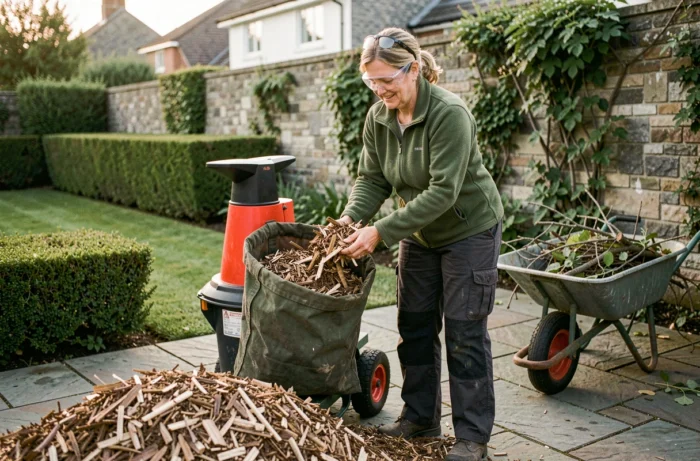
Maintenance and safety: what the test reveals in use
The initial assembly is quick. The funnel attaches by hand to the body of the shredder, and the device is operational in a few minutes. This point, confirmed by several tests, distinguishes the AXT 25 D from some competing shredders that require more tedious assembly.
Routine maintenance focuses on the knife rotor. The blades do not need to be sharpened as frequently as on a disc shredder, but cleaning after each session prevents the accumulation of fibrous residues. Residues of green wood left in place harden and gradually reduce cutting efficiency.
In terms of safety, the device features an automatic stop system when the hopper is opened. The included pusher allows for keeping hands away from the mechanism. These features are standard in the Bosch range, but their presence deserves to be highlighted in a test, as some entry-level shredders lack them.
Points of caution during grinding
- Never force a branch beyond the maximum diameter: the motor will lock, and reverse operation will repeatedly stress the mechanisms.
- Wear safety glasses, as wood splinters can be projected from the hopper, especially with dry and brittle wood.
- Empty the collection bin before it is full: an overloaded bin creates a backflow that accelerates jams.
The Bosch AXT 25 D fulfills its role as a silent electric shredder for a medium-sized garden, provided its limits are respected. Its knife rotor favors dry wood and moderate sections.
Those who regularly feed a compost with pruning waste will find a reliable device at a price point lower than turbine models. For large volumes of fresh vegetation or diameters frequently exceeding 4 cm, the AXT 25 TC remains the logical alternative in the same range.