
A pair of jeans with a hole in the knee, a coat with a peeling lining, a dress spotted on an online thrift store but not available in the right size: we often face a choice that’s anything but theoretical. Should we repair it, buy new from a responsible brand, or hunt for it second-hand?
The answer depends on the garment, your budget and how urgently you need it. Since September 1, 2026, a financial penalty has applied to ultra-fast fashion items sold in France, and an advertising ban for these brands in the media is set to take effect on January 1, 2027. The regulatory framework now encourages us to look beyond the price tag when making a decision.
Repair, buy new or shop second-hand: the practical trade-offs
It almost always starts with the same situation: a garment we wear regularly begins to show signs of wear. A seam coming undone, a sole peeling off, a stuck zipper. The most sustainable first step is to repair it.
The Textile Repair Bonus lowers the cost of repairs at an accredited professional. For hemming, replacing a zipper or mending a seam, it covers part of the bill. It’s the most direct way to extend the life of a garment already in your closet, without any emissions from manufacturing a new item.
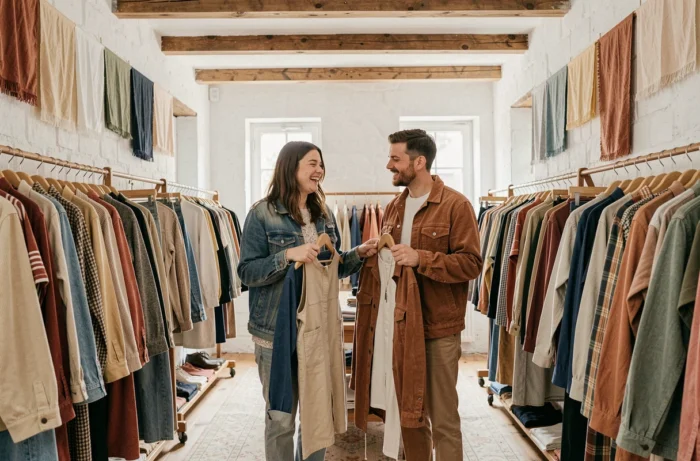
Second-hand shopping is the next option when the item isn’t already in your wardrobe or when repairing it would cost more than replacing it. Brick-and-mortar thrift stores, peer-to-peer resale platforms and specialist consignment shops: the market has become more established. The downside is availability. You won’t always find the cut, size or fabric you’re looking for, and the time spent searching also has a cost.
Buying new from a brand with responsible production practices makes sense when neither repair nor second-hand shopping meets your needs. Technical underwear, work shoes suited to a specific foot shape, or professional clothing that must meet certain standards: in these cases, buying new and choosing a better-designed product remains the most reliable solution. The point isn’t to rank these three options rigidly, but to choose between them based on the situation at hand.
Resources such as la Mode Éthique make it easier to identify brands that publish information about their manufacturing practices and material choices, helping you narrow down your options when buying new.

Environmental impact labels and textile penalties: what’s changing in France
Two recent measures are changing how we assess clothing before buying it. The first is environmental impact labeling. Since October 1, 2025, brands have been able to display an environmental score on clothing sold in France. The scheme is still voluntary, but governed by official standards. If a brand displays a score, it can’t make up its own criteria.
In practice, this score makes it possible to compare two cotton T-shirts on the same basis, beyond vague claims such as “eco-designed” or “responsible.” The current limitation is that few brands use it, which restricts the opportunities to compare products in stores.
The second measure is the penalty on ultra-fast fashion, introduced by the law enacted on July 8, 2026. Since September 1, 2026, a surcharge has applied to the items concerned. The penalty directly targets the business model of platforms with rapidly changing collections by raising the price of less durable items.
Destroying unsold textiles: the 2026 European rule
Since July 19, 2026, large companies have been prohibited from destroying unsold clothing, accessories and footwear under the European Ecodesign Regulation. The text allows for some exceptions, but the principle is clear. Medium-sized companies will be covered from 2030.
The ban encourages brands to plan production volumes more carefully rather than producing on a massive scale and disposing of surplus stock. For consumers, this means that sales and deep-discount clearance events may look different in the coming seasons.
The measure applies to destruction, not donation or recycling. Unsold items can still be directed to reuse or processing channels. The distinction matters: an unsold garment donated to a charity or returned to the second-hand market remains in the textile supply chain.
Materials and labels: what to look for when choosing durable clothing
When buying new, the raw material is the first thing to consider. Conventional cotton uses a lot of water and pesticides. Polyester, which is derived from petroleum, releases plastic microfibers with every wash. Alternatives are available, but each comes with limitations in terms of availability and price.
- Certified organic cotton (GOTS, OCS) guarantees that no synthetic pesticides are used and that the production chain is traceable, from field to finished garment
- European linen, grown mainly in France and Belgium, requires very little irrigation and no chemical defoliants
- Recycled fibers (recycled polyester, recycled cotton) reduce pressure on virgin materials, provided the recycling process itself is certified
- Tencel (lyocell), made from wood pulp, uses a closed-loop solvent system that limits chemical discharge
As for labels, GOTS, OEKO-TEX Made in Green, Bluesign and Fairtrade cover different areas. GOTS focuses on organic fibers and social conditions. OEKO-TEX Made in Green certifies that products are free from harmful substances and that production is traceable. Bluesign monitors chemical inputs from the fabric manufacturing stage. Fairtrade guarantees fair pay for producers.
No single label covers the entire supply chain. Looking for two labels on the same product gives you a more complete picture than relying on just one.
There’s no one-size-fits-all answer to the choice between repairing, shopping second-hand and buying new from a responsible brand. What has changed since 2025 is that French and European regulations now offer practical tools to guide that choice: environmental impact labeling, penalties on ultra-fast fashion, a ban on destroying unsold goods and the Repair Bonus. The key is to use these options one garment at a time, based on what’s already in your closet.