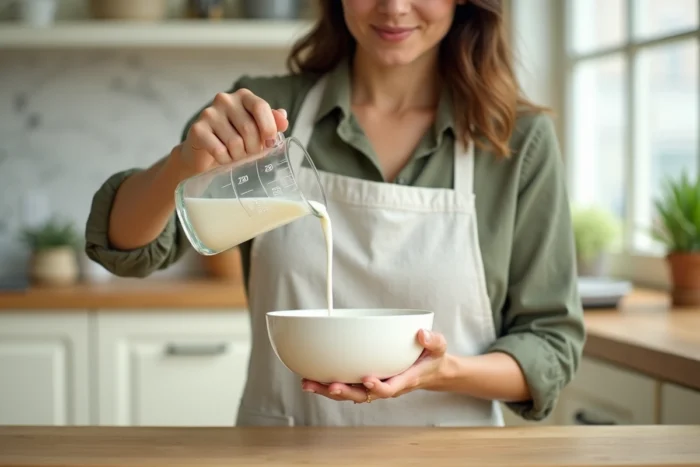
Converting 250 ml to grams may seem trivial, but the result varies depending on whether the container holds water, flour, or honey. The reason can be summed up in one word: density. One milliliter of water weighs one gram, which creates a perfect equivalence between volume and mass. Applying this same ratio to any ingredient introduces a dosage error right from the start.
Density of ingredients: the factor most conversion charts ignore
The basic formula is simple: mass (g) = volume (ml) x density. For water, the density is 1, so 250 ml of water is exactly 250 g. Milk, which is very close to water in density, gives a nearly identical result.
Discrepancies quickly widen with other ingredients. Flour, for example, is significantly less dense than water: 250 ml of flour weighs much less than 250 g. Honey, on the other hand, is denser: 250 ml of honey far exceeds 250 g on the scale.
To master the conversion of 250 ml to grams, it is essential to know the density of each ingredient before any operation. Without this data, a generic “ml = g” chart remains misleading.
Conversion chart for 250 ml to grams by ingredient
The references below cover the most common ingredients in cooking and baking. The values are indicative, as density can vary slightly depending on the brand or grain size.
| Ingredient | Approximate Density | 250 ml in grams |
|---|---|---|
| Water | 1.00 | 250 g |
| Whole milk | 1.03 | about 258 g |
| Melted butter | 0.91 | about 228 g |
| Wheat flour | 0.55 to 0.65 | about 138 to 163 g |
| Granulated sugar | 0.85 | about 213 g |
| Honey | 1.40 | about 350 g |
| Vegetable oil | 0.92 | about 230 g |
The gap between flour and honey is striking: for the same volume of 250 ml, the weight varies from one to two times. Measuring by volume without correcting for density skews the recipe, especially in baking where a few grams can change the texture of a sponge cake or a macaron.
Volume or scale: choosing the right tool for the recipe
A graduated measuring cup is sufficient for liquids whose density is close to 1 (water, milk, broth). The reading error remains minimal if the container is placed on a flat surface and one looks at the meniscus at eye level.
For powders and solids, the question becomes more delicate. Three parameters skew volume measurements:
- The packing of the ingredient in the container: flour poured freely into a measuring cup weighs less than the same flour packed with a spoon, for the same volume.
- The grain size: granulated sugar and powdered sugar do not occupy the same space for the same weight.
- Ambient humidity: flour or cocoa powder absorbs moisture from the air, which alters their density over time.
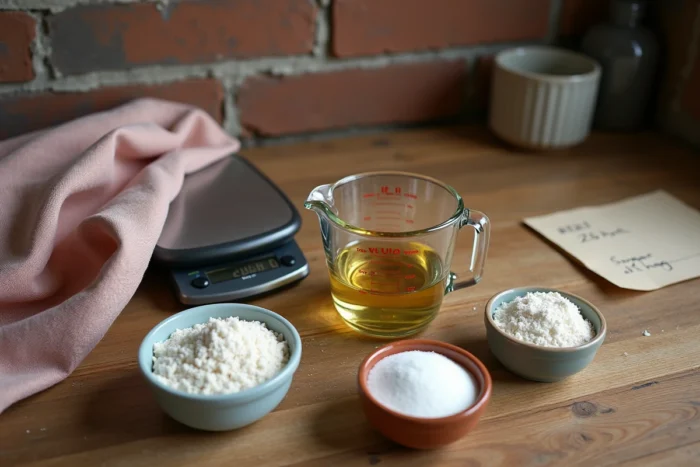
For baking recipes that require precision (macarons, sponges, yeast doughs), the scale remains the most reliable tool. It eliminates any ambiguity related to density or packing.
The case of eggs and butter
Eggs present a particular problem: their volume is not standardized. A medium egg does not weigh the same as a large egg, and the proportion of white to yolk varies. Weighing eggs one by one, or weighing the white and yolk separately, ensures reproducible dosing.
Butter, on the other hand, is easily measured by weight thanks to the markings printed on the packaging. Converting it to milliliters is only relevant if it is melted, in which case its slightly lower density than 1 gives about 228 g for 250 ml.

Practical equivalents with everyday utensils
Anglo-Saxon recipes often use the “cup” as a unit of volume. Beware: the American cup contains about 237 ml, not 250 ml. The metric cup, used in Australia, corresponds to 250 ml. Confusing the two in an imported recipe skews all proportions.
For those who have neither a scale nor a measuring cup, here are common references using kitchen utensils:
- A level tablespoon contains about 15 ml of liquid.
- A level teaspoon contains about 5 ml of liquid.
- A standard mustard glass contains about 200 ml.
These equivalents only apply to liquids. For powders, the weight of a tablespoon varies by ingredient: a tablespoon of flour does not weigh the same as a tablespoon of sugar.
Avoiding dosage errors that ruin a recipe
The first source of error is treating all ingredients as if they were water. Pouring 250 ml of flour thinking it equals 250 g results in an overdosage of about one-third, leading to a dry and compact dough.
The second error concerns packing. Filling a measuring cup with flour by packing it with the back of a spoon significantly alters the weight obtained. The best practice is to spoon the ingredient into the container without shaking or compacting, then level it off with the back of a knife.
A successful recipe relies on the right tool at the right time: measuring cup for liquids, scale for powders and dense ingredients like honey or butter. Keeping a small density chart in the kitchen, or memorizing the three or four most common equivalents, is enough to secure the vast majority of preparations.