
Birkenstock sandals are based on a precise technical principle: a molded cork-latex sole that conforms to the arch of the foot, with a footbed shaped in three support zones. This anatomical sole concept, long associated solely with the German brand, is now found among several manufacturers who offer different approaches to foot support, at various prices and with varied materials.
Before comparing brands, it’s essential to understand what truly distinguishes an anatomical sandal from a classic flat sandal, and why not all alternatives are equal in terms of comfort.
Anatomical sole and arch support: what Birkenstock’s competitors are copying
The Birkenstock footbed is characterized by marked arch support, a heel cup, and a slightly raised toe area. This profile forces the foot to position itself in a specific way, relieving certain pains but not suitable for all foot shapes.
Competing brands replicate this principle with variations. Some, like El Naturalista, mentioned by Le Figaro Style as a serious alternative, maintain comparable arch support while using leathers tanned through processes presented as more environmentally friendly. Others intentionally move away from this.
The barefoot movement (minimalist sandals with flat, flexible soles) takes the exact opposite approach to Birkenstock. Specialized brands like Petits Pas de Géant highlight user feedback showing a reduction in foot pain and an improvement in stability after a period of gradual adaptation. The principle: allow the foot to work without artificial support rather than locking it into a mold.
Asking which alternative to Birkenstock to choose thus comes down to deciding between two opposing philosophies of foot comfort, not just between two brands.
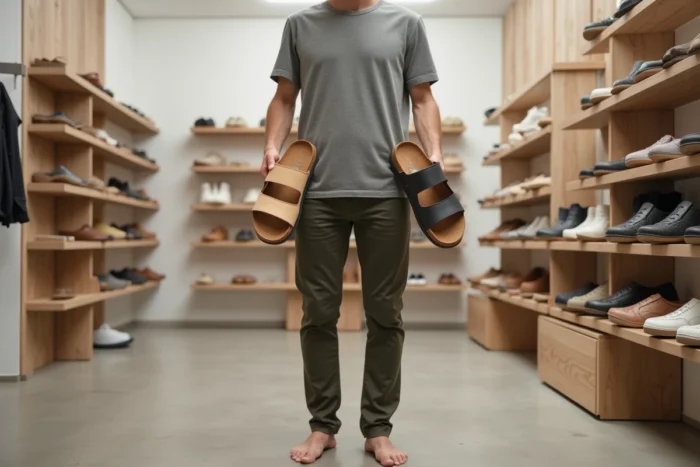
Bayton, Crocs, El Naturalista: three brand profiles to compare
Grouping all alternatives into one category makes no sense. Each brand targets a different use, budget, and style.
Bayton: accessible price positioning
Bayton offers sandals with shaped soles at a price point significantly lower than Birkenstock. The models take visual cues (adjustable buckles, visible cork sole) with synthetic or semi-synthetic materials. Short-term comfort is adequate, but the durability of the soles over multiple seasons is often cited as the main weakness by users.
Crocs: foam comfort and fashion segment
Crocs has repositioned itself in recent years in the everyday comfort segment, beyond its resin clogs. The brand benefits from strong momentum, with financial analysts like Piper Sandler recommending the stock. The comfort relies on Croslite foam (closed-cell resin), not on an anatomical cork footbed. The sensation is more cushioning than supportive, which suits those who find the Birkenstock profile too rigid.
El Naturalista: the eco-friendly anatomical alternative
El Naturalista maintains a comparable arch support to Birkenstock while showcasing a commitment to material traceability. The brand is less known to the general public but is gaining visibility in the French fashion press. The price falls within the same range as Birkenstock, sometimes slightly above.
Selection criteria based on use: city, beach, or light hiking
The context in which the sandal will be worn determines the type of sole and suitable materials. Here are the criteria to prioritize according to three common use cases:
- Daily urban use: prioritize marked arch support and a sole that absorbs shocks on hard surfaces. Models with cork footbeds (Birkenstock, El Naturalista, high-end Bayton) are the most suitable.
- Beach and wet environments: materials must resist water without deforming. Foam soles like Croslite or EVA models have an advantage over cork, which does not handle prolonged immersion well.
- Extended walking or light hiking: the rigidity of the sole and the depth of the heel cup become crucial. A sandal that is too soft tires the foot over long distances, while a model that is too rigid can cause friction.
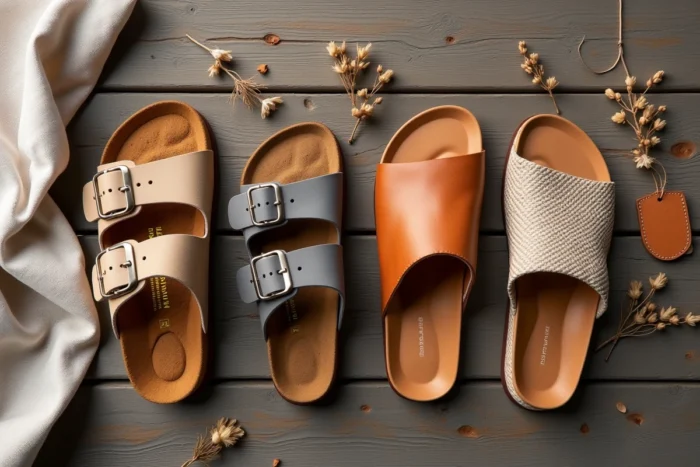
Vegan and eco-friendly sandals: a segment that structures the market
The question of materials no longer concerns just mechanical durability. A growing share of buyers seeks models without animal leather, which eliminates part of the Birkenstock catalog (even though the brand offers lines in synthetic Birko-Flor).
Brands like Minuit sur Terre exclusively position themselves in this niche with shaped sandals made without any animal-derived components. The compromise often lies in longevity: current synthetic leathers age differently than full-grain leather, with a tendency to crack after several seasons of intensive use.
The choice between animal leather, vegan leather, and technical synthetic materials is not just ethical. It directly influences foot breathability, break-in time, and the behavior of the insole over time.
Mules and closed sandals: models that go beyond the Arizona format
The Arizona (two straps, open toe) remains the most copied model. The most relevant alternatives are not limited to this format. Closed mules like the Boston, which have become a fashion phenomenon, find equivalents at Bayton and Crocs with radically different approaches to rear support.
On closed models, ventilation becomes a technical criterion that should not be overlooked. A cork clog with a leather lining breathes better than a molded resin clog, but the latter can be cleaned in seconds under water. Each format imposes its compromises.
The market for anatomical sandals has diversified enough that no brand dominates all criteria simultaneously. The best choice depends on the trio of use, budget, and sensitivity to materials, not on a universal ranking. Physically testing the footbed remains the only reliable way to assess comfort, which varies significantly from one foot shape to another.