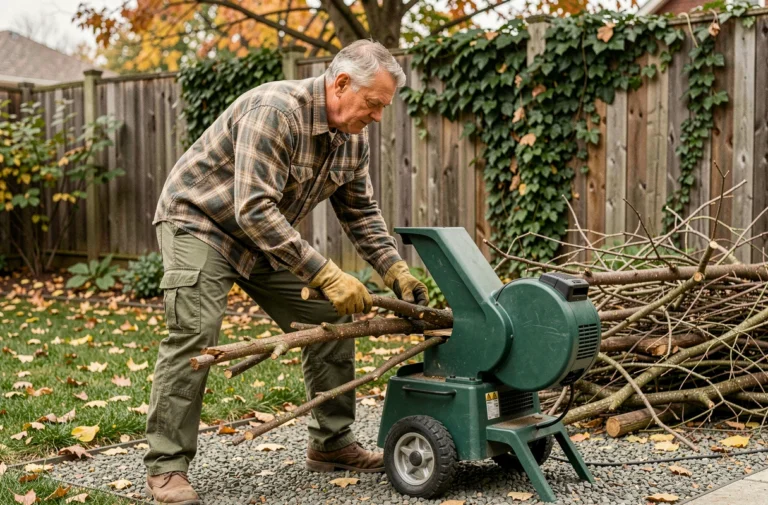
Sports coaching equipment is not just a list of accessories piled in a bag. Each piece of equipment serves a specific purpose: protecting a joint, allowing for load progression, or ensuring the safety of the practitioner during a guided movement. Choosing equipment for sports coaching sessions requires first understanding the purpose of each category of equipment, and then adapting it to the location and type of coaching.
Elastic resistance or free weights: two different training logics
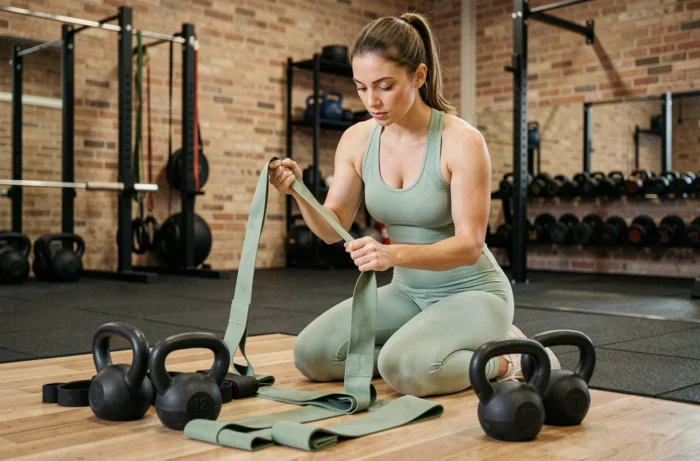
Before comparing products, it’s important to distinguish between two families of resistance. Elastic bands offer progressive tension: the more you stretch, the greater the resistance. Free weights (dumbbells, kettlebells) apply a constant force related to gravity. These two logics do not engage the muscles in the same way.
Elastic bands are suitable for mobility exercises, joint warm-ups, and rehabilitation. Their compactness makes them practical for home or outdoor coaching. Free weights allow for heavier strength training, with precise control over the weight lifted.
A coach who works in multiple locations benefits from combining the two. To explore all the equipment offered by Quel Coach, this distinction between elastic resistance and free weights serves as a good starting point before any purchase.
Training surface and sports mats: what the ground imposes
The sports mat is not a comfort accessory. It is a safety element that protects the joints during floor exercises (planks, push-ups, stretches). Its thickness and density must correspond to the type of movements performed.
A mat that is too thin on a hard surface (tile, concrete) transmits impacts to the knees and elbows. A mat that is too thick destabilizes support during standing exercises. For general fitness or home coaching, an intermediate thickness offers the best compromise between cushioning and stability.
When the training location changes the constraints
Indoor coaching generally has an appropriate surface. Outdoors or at a client’s location, the coach must provide their own surface. The weight of the mat then becomes a criterion: a model that is too heavy complicates daily movements between multiple sessions.
The Perplexity research highlights a often overlooked point: a coaching space open to the public may fall under the regulations of establishments receiving the public (ERP), with specific obligations for accessibility and safety. The choice of premises directly transforms the constraints related to the equipment.
Strength training equipment for coaching: concrete selection criteria
Adjustable dumbbells, kettlebells, and suspension straps (like TRX) form the most common trio in sports coaching. Each meets a distinct need, and confusing them leads to unnecessary purchases.
- Adjustable dumbbells allow for load modulation in increments, making them suitable for the progression of both beginner and advanced practitioners. Their versatility covers most classic strength training exercises.
- Kettlebells engage the posterior chain and dynamic core stabilization more. Their asymmetrical shape requires a technical learning process that the coach must master before offering them.
- Suspension straps utilize body weight at variable angles. They attach to an anchor point (door, tree, structure) and are particularly suitable for outdoor sessions or in confined spaces.
The main selection criterion remains the client’s profile. A program focused on weight loss and fitness does not require the same equipment as a targeted muscle strengthening program.
Traceability and maintenance of equipment: an angle that shopping lists ignore
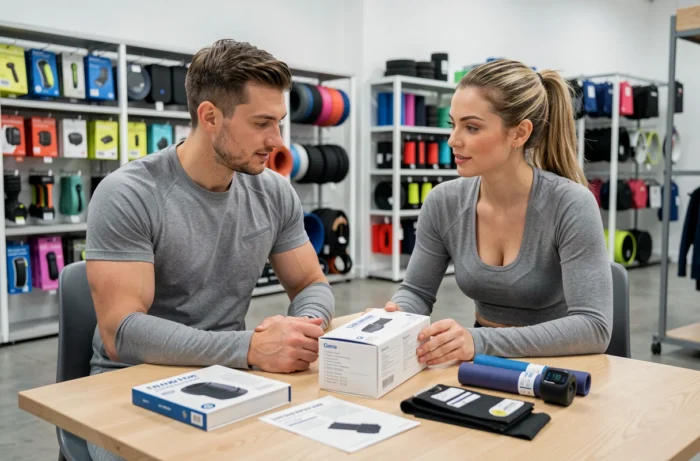
Buying coaching equipment does not stop at price comparison. According to research data, fixed or collective equipment must be subject to documented checks. A coach who installs a weight cage, a wall-mounted pull-up bar, or any fixed device should require from the manufacturer a technical manual, maintenance instructions, and a history of inspections.
Dangerous equipment (frayed cables, worn straps, collapsed protective foam) must be removed immediately. This rigor is not merely a matter of caution: it engages the coach’s responsibility in the event of an accident during a training session.
Professional qualification and equipment: two related subjects
Professional equipment does not compensate for the lack of qualification. Paid sports coaching in France requires a recognized diploma (BPJEPS, DEJEPS, STAPS license depending on the case) and a declaration to the competent administrative authority. The professional card remains mandatory to practice legally, regardless of the level of investment in equipment.
Recovery and complementary accessories for coaching sessions
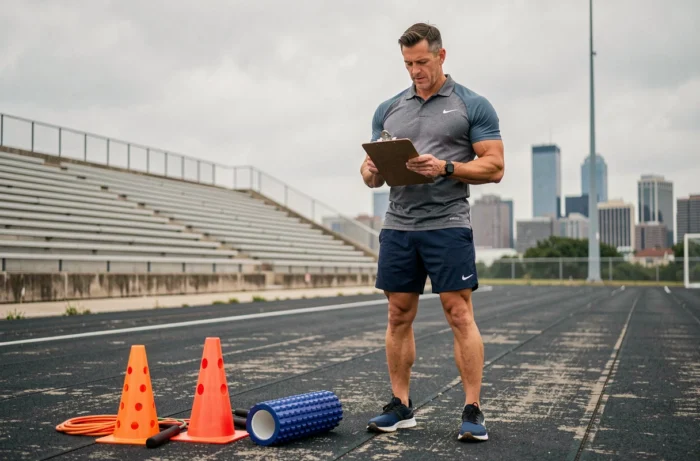
Recovery tools (massage rollers, mobility balls) usefully complement a coaching kit without burdening the budget. They allow the coach to integrate structured cool-down phases, which enhances the client’s experience and reduces the risk of excessive soreness.
The water bottle, often relegated to the obvious, deserves a technical mention: hydration during exertion conditions performance and muscle recovery. A coach who consistently provides this reminder to their clients structures their sessions better than a coach who omits it.
The choice of equipment for sports coaching relies on three successive filters: the type of exercises performed, the location of the sessions, and the ability to maintain the equipment over time. A limited but suitable kit for the clients’ profiles yields better results than an excessive stock poorly utilized.